
SPEA2: Strength Pareto Evolutionary Algorithm 2#
SPEA2 is a well-established multi-objective evolutionary algorithm. It improves upon the original SPEA by combining a fine-grained, strength-based fitness assignment with a density estimate, and by using an environmental selection that keeps the number of non-dominated solutions stable through an archive truncation operator.
Key Features#
Strength-based fitness: Each individual’s raw fitness is the sum of the strengths of the solutions that dominate it, where an individual’s strength is the number of solutions it dominates. Lower values are better, and all non-dominated solutions receive a raw fitness of zero.
Density estimation: To break ties among non-dominated solutions, a density term based on the distance to the k-th nearest neighbor in objective space is added to the raw fitness, promoting a well-spread front.
Environmental selection with truncation: A fixed-size archive of the best individuals is maintained across generations. When too many non-dominated solutions exist, a truncation operator iteratively removes the individual with the smallest distance to its neighbors, preserving diversity.
Example#
[1]:
from pymoo.algorithms.moo.spea2 import SPEA2
from pymoo.problems import get_problem
from pymoo.optimize import minimize
from pymoo.visualization.scatter import Scatter

problem = get_problem("zdt1")

algorithm = SPEA2(pop_size=100)

res = minimize(problem,
               algorithm,
               ('n_gen', 200),
               seed=1,
               verbose=False)

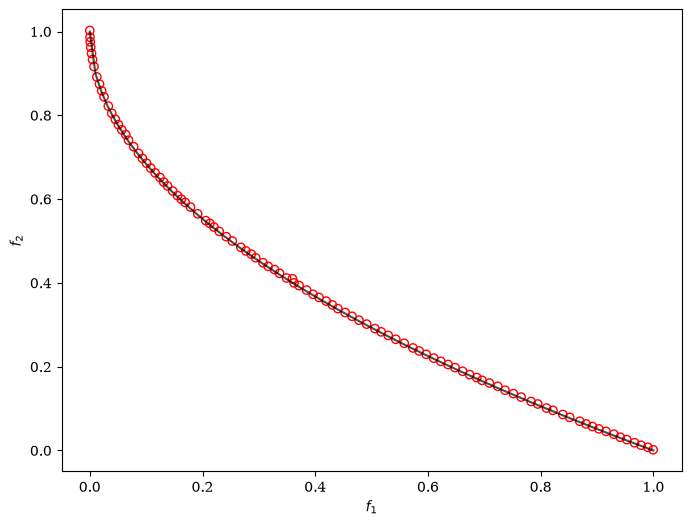
plot = Scatter()
plot.add(problem.pareto_front(), plot_type="line", color="black", alpha=0.7)
plot.add(res.F, facecolor="none", edgecolor="red")
plot.show()
[1]:
<pymoo.visualization.scatter.Scatter at 0x703a916e81d0>
SPEA2 is a drop-in multi-objective algorithm and uses the same modular operators (sampling, crossover, mutation) as the other genetic algorithms in pymoo, so it can be customized in the same way.
API#
References#
Zitzler, E., Laumanns, M., & Thiele, L. (2001). SPEA2: Improving the Strength Pareto Evolutionary Algorithm. Technical Report 103, Computer Engineering and Networks Laboratory (TIK), ETH Zurich.